Sunday, 13 March 2016

Why The Jedi Are Hilariously Underpowered

Yes, yes, I know what you're thinking - yet another random internet rant about some aspect of Star Wars that doesn't make sense.

And you're correct. So shut up and sit down.

My complaint today doesn't actually revolve around a scientific inaccuracy in Star Wars. There's plenty of them to pick from. No, today's qualm is more of a political one. Put simply - why on Earth does anybody really care about the Jedi?

I mean - what's the point?

Through seven movies now, only occasionally have we ever seen the Jedi do anything remotely powerful enough to make an entire galaxy of beings quake in fear. I mean, that is meant to be the point isn't it? The Jedi are keepers of the peace. They're the galactic police force. If one planet goes to war with another planet. the apparent policy is that Coruscant just dispatches a couple of Jedi to 'settle the conflict'.


Yet why does anyone actually fear the Jedi? What powers do they possess that means they can 'settle' anything? The basic ones should be pretty obvious - telekinesis, enhanced speed and reflexes, as well as 'mind tricks' that you can use to control people's actions. Oh, and laser swords - really cool laser swords.

Other abilities include some degree of precognition, the ability to partly come back from the dead as a 'force ghost' and being able to shoot lightning from your fingers (or 'lightning hands') for some dark side users.

That's a pretty wide array of cool stuff. So what's my point?

Well of the above abilities, I would have to say mind tricks and precognition are by far the most useful. The ability to control other people's actions would made them unique spies, saboteurs, interrogators and advisers. The CIA would hire them in a heartbeat.

As for the military however...what exactly is the appeal?

At no point do we see the Jedi using telekinesis on a scale I'd say would be significant on even a 20th century battlefield. A while ago xkcd tried to estimate how much 'force power' Yoda could generate by examining the scene where he lifts Luke's X-Wing out of the swamp. He estimated that since the X-Wing might have weighed about five tonnes (comparing it to an F22) and given the speed at which it moved upwards, Yoda might have generated about 20 kilowatts of energy - or about 25 horsepower.

http://what-if.xkcd.com/3/


Admittedly, the prequel trilogy contains some examples that appear to be much larger. Near the climax of Attack of the Clones we see Yoda hold up a pillar toppled by Count Dooku so that it doesn't crush Obi-Wan and Anakin. 


I''d estimate the length of the pillar to be about eight meters. That makes it maybe 1.5 meters in diameter. It appears to be made of metal, and we don't know if its hollow or not, but lets assume it isn't. The density of steel is about eight times that of water. 

We end up with an estimate of 8X0.75X0.75XpiX8 = about 113 tonnes.

This is an impressive amount. An M1A1 Abrams weighs about 60 tonnes for instance, so supposedly Yoda could flip them over or perhaps crush them if he concentrated.

Even here however, at what seem to be the very limits of the Jedi's power (Yoda is meant to be one of the most powerful) they hardly seem able to compete with modern weapons. Then again, I'm reminded of the climax of X-Men First Class where Magneto stops the barrage fired by the naval vessels off shore.


The total mass of all those shells and missiles is probably less than one hundred tonnes, implying Yoda could perform a similar feat. So on 20th century Earth Jedi might still be dangerous, but you'd still probably need an army of them to pose a real threat to the world.

In a galaxy far, far away however, filled with thousands of worlds and millions of spaceships, how exactly are the Jedi so scary? On the list of dangerous weapons, surely they should be somewhere behind atomic bombs, relativistic projectiles, giant space lasers and antimatter munitions?

If the Jedi were to make any sense. They would have to be vastly more powerful. They should be able to make entire planets quake at fear with their mere presence. Oddly enough, their powers are sometimes much greater in the Star Wars expanded universe. Take this clip of Yoda from the 2003 Clone Wars cartoon for instance.


Now this is more like it. Here you see thousands of droid soldiers crumpling before a Jedi's power. With abilities as depicted here, its easy to imagine a powerful Jedi leveling much of Manhattan in an afternoon, Godzilla-style. Already you may be starting to wonder - what is the point of those fancy laser swords if they are this strong with the force?

This is still not quite what I'm talking about however. The Galaxy is a big, big place, consisting of many thousands of populated worlds. Although we may never get exact numbers, there are probably more planets than Jedi - i,e, a ratio of one Jedi per planet or less. You have to think of a single Jedi being able to intimidate a whole planet, to be able to threaten its populace with swift destruction if they get too uppity - and these are planets with technology that is generally centuries ahead of our own.

No - Jedi should be on a whole other level to what we've seen depicted in the Star Wars films. They should be godlike. They should be on a similar level to beings like Superman, Goku or Dr. Manhattan. They should be able to demolish entire cities with just a thought. They should be able to snap battleships - even space-bound ones, in two like matchsticks. Their wrath should be comparable to a force of nature, easily mistakable for an earthquake or a hurricane. #ChuckNorrisFacts should pretty much apply to them. At their full power they should be capable of killing millions, of rendering entire worlds uninhabitable, if not dismantling them entirely.

They should not be these moody guys in robes who fuck around with laser swords.

Honestly - not only would this make more sense, I think Star Wars would have been a lot cooler because of it. Perhaps Luke Skywalker should have been like Elsa from Frozen - growing up barely in control of his powers, afraid at any moment he would kill someone, before Obi-Wan comes along and shows him how to control them. The X-Men movies also deal very well with the real-world implications of people having superpowers, including isolation, discrimination, fear and arrogance. 

Since it originally started off as a fairly low-budget, niche sci-fi flick, I suppose we can forgive Star Wars these flaws, but damn, the Jedi could have been so much cooler.

Reviewing the Idiran-Culture War

A major event in Iain M. Bank's seminal 'Culture' series of novels is the 'Idiran-Culture War'. Only the novel 'Consider Phlebas' is set during it, and even then the war mostly serves as background. Thereafter it is relegated to a historical event (as the books can be separated by centuries) but is repeatedly mentioned in a way reminiscent of the World Wars today.

The Culture series is relatively hard science fiction, though many of the technologies it involves would be considered extremely advanced by our standards. Faster-than-light travel also exists as well, but despite this, the series portrays the details of both domestic and interstellar politics with great skill.

The war unfolds (obvious spoilers) in a manner similar to our own WW2-era Pacific War, with the Idirans in the role of the Japanese and the Culture as the Allies (particularly the Americans).

The Idirans are described as the peak of biological evolution, having emerged as the 'top monster on a planet full of monsters'. They are also biologically immortal (i.e. they don't age) and for reasons along these lines they have a serious case of what you could metaphorically describe as 'white man's burden'. They believe themselves superior to all other races and that they have a divine destiny (there are religious undertones here as well) to spread out across the universe and rule the 'lesser' races.

There have been various fan-art depictions of the Idirans given their physical description in the books. This is probably my favourite -

^ The Master Race - as imagined by Iain M. Banks

The Culture meanwhile, could be described as the ultimate hedonists. They are an advanced society all-but free from violence, disease, poverty, money, religion and all other forms of civil ailment. This has been achieved largely by the 'post-scarcity' nature of their economy. They're so advanced in fact, that they no longer even live on planets, considering them useful only as 'nature preserves'. Instead they live on massive spaceships or artificial habitats (think Dyson Spheres and ringworlds).

Here then, we see the comparison between the utterly racist, expansionist, fundamentalist Idirans and the supremely carefree, happy-go-lucky Culture. This is reminiscent of (though greatly exaggerated) the Japanese Empire and the western democracies in WW2.

As for the course of the war, in its initial stages the Idirans conquer a vast number of worlds, while the Culture retreats into the depths of interstellar space and begins ramping up its war production (as they had previously been a peaceful society with no dedicated warships).

The war lasts decades, before the Culture begins launching strikes deep into Idiran territory. Eventually another advanced race who are major supporters of the Idirans - the Homomda, withdraw from the conflict, at which point the Idiran's fate is sealed. In the closing stages of the war they resort to increasingly desperate tactics to change its outcome (including blowing up a bunch of stars) before, after a total of forty-eight years of war, their homeworld is reached by the Culture and their empire dismantled.

Any history students should see the parallels here to the Pacific War. Imperial Japan emerged out of the chaos of the archipelago's medieval period, when it was divided up into many different feuding states. After being isolated so many hundreds of years, Matthew Perry's visit to the islands in 1854 forced Japan to end its isolation and begin modernizing. This led it on a campaign of conquest in East Asia that mirrored those being carried out by European states from halfway across the globe.

In the opening months of the war - essentially from Pearl Harbour to Midway - the Japanese conquered large parts of the Pacific and East Asia, running rampant everywhere from India to Hawaii. After that their expansion came to a halt while the Allies counterattacked. In a series of bloody campaigns from Guadacanal to the Philippines the Allies gradually gained the upper hand. Eventually, closing in on the Japanese home islands, they resorted to the atomic bomb to force Japan into submission.

More than this however, we can see than Iain M. Banks did not choose this comparison randomly.

The Pacific War was, more than most combat theaters, an amphibious war. Army troops were useful only for garrisoning islands. The decisive battles were all fought at sea.

The islands of the Pacific, then, can be compared to individuals star systems and planets on the galactic scale. Assuming that planets are still your targets in any interstellar war (far from a certainty) the key battles will surely be fought far from a planet's surface. Battles in deep space between warships - likely run by autonomous AIs and built in vast numbers, will decide the fate of worlds.

Planetary battles would be somewhat like the marines storming ashore on Guadalcanal or Iwo Jima. Rarely was a naval assault actually repulsed in WW2. Once the enemy's fleet is parked off-shore (or in this case in-orbit) your fate is basically sealed. Without quick reinforcement, it is only a matter of time, and lives.

Bombardment from above - either from planes and Battleships in WW2 or orbiting cruisers in space, would be used to soften up the defenders. Assuming you needed to actually capture the world (and not just destroy it outright - which may be deemed prudent depending on the circumstances) the next step would be to send in the starship troopers.

Just as the Japanese built complex systems of trenches, caves and bunkers from which to defend their positions, a defender on a planetary surface could bury deep into its crust to avoid the preliminary bombardment. Most of the Allied bombardments proved useless against the well-entranced Japanese, requiring weeks-long campaigns of brutal ground fighting to root them out. Even then, in many cases, small groups of Japanese held out even after an island was 'secured', often for years.

Again, on a planet, even advanced weapons such as nukes and lasers will have difficulty attacking positions buried many kilometers into the Earth. The deepest mine on Earth currently is the Tautona gold mine in South Africa, at 3.9 kilometers deep. With great need and more advanced technologies however, its not hard to see us exceeding this depth by quite an amount. The Earth's crust averages 30-40 kilometers thick beneath the continents, though this increases to close to a hundred in some places (particularly under large mountain ranges like the Andes and Himalayas).

The infamous fanaticism of the Japanese could also be paralleled by soldiers far from human. These could be either advanced machines or creatures that have been genetically modified in some way. In all seriousness, think of Terminators or even Transformers - and self-replicating ones at that. Imagine such a machine burying into the Earth, perhaps via  existing mineshafts or underground tunnels, and slowly making copies of itself deep underground. Then one day, perhaps years later, a whole army of them bursts forth from the ground, set on re-conquering the surface once more.

In this way, a defending force could wage a guerrilla war against the surface occupiers of a world almost indefinitely. Assuming they had a manufacturing capacity of some kind (and there are plenty of metals and lots of geothermal energy to facilitate this in the depths of the Earth) they could retreat and regroup there before launching regular attacks on the surface. Presumably the purpose of this is not so much to liberate the world as to make things uncomfortable for the occupiers, perhaps compelling them to abandon the planet someday.

As far as I'm aware, such a scenario has not really been depicted in science fiction before. Many of the separate elements are there - we've seen terminators and Red Dawn-style guerrilla warfare and underground cave systems, but I don't think anyone has yet married these different elements fully. This is a shame, as such a strategy actually seems to make sense, and may very well happen one day.

In fact, since no one else seems to have thought of this, I'm going to coin a new term here - 'Lithospheric Guerrilla Warfare'.

The 'lithosphere' of a planet is its solid outer surface. This includes not only the crust but the viscous uppermost part of the mantle. I find it difficult to imagine than any creatures or machines could actually operate in the mantle itself, the laws of material science don't appear to allow it, but anywhere in the crust could be fair game, and eventually become a battlefield. The term 'terranaut', which somebody else has already coined (I recall hearing it in the movie 'The Core' - otherwise a thoroughly awful film by the way...), could very well be used here.

Just as wars have previously been fought on land, at sea, in the air (over the last century or so) and theoretically could occur in space, countries may one day be compelled to create a 'Terranaut Corps' as well. Already we have precedents like the WW1-era Battle of Messines. British miners spent months tunneling under the German lines before detonating 19 enormous piles of explosive - almost 500 tons in total, beneath them in preparation for an attack. Ten thousand German soldiers were killed in moments, still the deadliest non-nuclear explosion of all time. The blast was loud enough to be heard in London and Dublin, hundreds of kilometers away.

Early Lithospheric Warfare (film - Beneath Hill 60)
While science fiction talks often of 'holding the high ground' in a battle - i.e. space, controlling the low ground could be just as essential. Imagine doing what the British did in 1917 - but with nukes. Consider digging a tunnel, perhaps one tens or even hundreds of kilometers long (projects like the Channel Tunnel prove this is possible) to sites beneath major cities, or other targets. Imagine how much damage a large nuke could do if buried a few hundred meters below London or Tokyo.

Of course, I'm talking about all this in a theotetical, currently-relegated-to-science-fiction sense. I'm not saying we should be worried about Al Qaeda tunneling from Afghanistan to New York and setting off a bomb, but I don't see any fundamental reason why an attacking (or even more-so a defending) army might not do this in the far-future. Wait until the enemy's forces have landed, then set off a bomb right beneath their camp. By doing this repeatedly, a resisting force could make a world untenable for an occupying force to live in.

I wonder if the Idirans thought of this,

Sunday, 3 January 2016

Why Human Beings Will Never Colonize Other Planets

If you're someone who is remotely interested in space, you won't have failed to notice the headlines that pop up every few months about scientist’s latest discovery of a 'potentially habitable planet' – ‘Hey look, we found a planet only twice as large as the Earth, possibly orbiting in the habitable zone of its star, that's only 400 light years away!’
Now yes, I'm not saying we should ignore the latest Kepler discoveries. Nobody has ever done this before, and the spotting of more than 2,000 exoplanets since 1988 is indeed a scientific milestone. Personally, I remain a huge fan of SETI.
But as someone who (secretly) hopes to earn my stripes as a hard science-fiction author someday, I can't help but remain a bit skeptical. Will these far-flung worlds ever really affect the destiny of the human race?
Might it not be the case that, in however many centuries it takes us to reach them, we come up with much better alternatives when it comes to finding a place to live? Might these worlds become obsolete long before anyone has a chance to do their Neil Armstrong impression?
Let’s step back for a moment.
Say all of 21st century humanity, as we know it, was just a tribe from the Stone Age living in a cave somewhere. It’s a cave, but it’s a nice cave, nestled in a hillside, over a river, surrounded by fertile soil. Not a bad place to live.
Now imagine one of the young hunters goes off exploring, and returns a few days later with exciting news.
Hey guys! You'll never believe what I found! There's another cave we could live in! I mean...its kinda small, its filled with poisonous moss, oh and its in the middle of the desert...two hundred miles away, but still!’
And indeed, maybe some members of the tribe eventually do make the arduous journey and attempt to live there. Maybe they even find it tolerable, and this sets a precedent, with other bands setting off to colonize caves of their own.
In this manner, Stone Age humans might have crossed entire continents, seeking out more and more caves in which to live. In time, Civilization might have arisen from these underground refuges. Underground wars would have been fought. Cave-based empires would rise and fall. Shakespeare might have written Hamlet under the stalactites.
Indeed, if you had gone back and asked whatever budding science fiction writers may have existed in 10,000BC, this is how they might have pictured the future - a world in which humanity spreads across the Earth, inhabiting every single cave? Whoa!
There's a little flaw in this story though, an unexpected factor that makes this just an alternate history. While humans have sometimes lived in caves, civilization as we know it did not ultimately center on their existence. At some point, someone invented an alternative form of habitation, one that proved superior to caves in most respects.
We call them houses.
The Rise of the Cosmic House
In case it’s not clear what I'm on about, the caves in this analogy are the planets themselves. As for the houses - that's a little harder to describe. So what is the interstellar equivalent of a house?
While the cave analogy is mine, I can't claim credit for this entire idea. We have already seen it in works from authors like Iain M. Banks and Stephen Baxter.
In Banks's 'Culture' universe, most citizens of the advanced, star-spanning Culture live on enormous, galaxy-crossing spaceships or giant, artificial habitats. Planets are considered little more than nature preserves, inhabited by primitive races yet to develop spaceflight.
I also recall a Stephen Baxter story where a character becomes the first man to land on an asteroid. At first, he's little known, with most of the glory going to the first man on Mars. In time however, the Martian cities decline, the planet is largely abandoned, and the bulk of humanity ends up living in space. The protagonist does to the Martian Neil Armstrong what Christopher Columbus did to Leif Erikson.
In the end, it is those who leave a lasting legacy that achieve true glory. Space is where our future lies, not planet-bound like our ape ancestors.
Many studies have been conducted in to what future space habitats may look like. The jumbled mess that is the International Space Station will be looked back upon as the first roughly hewn raft our ancestors assembled on a beach somewhere.
Names like Bernal Sphere, Stanford Torus and O'Neill Cylinder have been floating around for a while now. These consist of different versions of what is essentially the same thing - a rotating space habitat.
The basic idea is that space habitats need to rotate in order to produce centrifugal force, thereby imitating the gravity of a body like Earth. These generally take the forms of cylinders, wheels or spheres. A cylinder a thousand meters across, for instance, would need to rotate about once a minute to approximate 1G.
There's no reason to believe such habitats could not be built in the near future. I'll stress again - this is science, not science fiction.
A very early example would be ‘Space Station One’ - the rotating wheel we see early in 2001: A Space Odyssey. The building of much larger habitats is certainly possible. ‘Rama’ from Rendezvous with Rama (also by Arthur C. Clarke) is a larger example, being a rotating cylinder some fifty kilometers long and twenty wide. 
I can even imagine looking up at the night sky in a hundred years or so and seeing hundreds of cylinders, spheres and wheels the size of cities orbiting the Earth. Probably the best description of this we've seen so far would be Alastair Reynold's 'Glitter Band' of ten thousand space habitats orbiting the planet Yellowstone in his Revelation Space novels.
Some authors have presented us with even larger structures, such as the Halo Ringworlds (about 10,000km across), Iain M. Banks' Culture Orbitals (3 million km across) and Larry Niven's titular Ringworld (300 million km across!)
Of course, the ultimate extension of this principle is a ‘Dyson Sphere’a swarm (NOT a solid shell) of enormous solar power collectors partially or entirely surrounding a central star. Such a structure, if placed around our own sun, could collect nearly a million, billion times as much energy as current global electricity consumption.
So one has to ask - amidst all this, what place is there for planets?
Planets vs. Space Habitats: A Losing Battle
When it comes to qualify of life, planets just can't compete.
For starters, planets are horrendously inefficient users of space. The whole point of a sphere is to minimize the surface area of an object after all, making planets literally the worst possible option.
The Earth weighs nearly six trillion, trillion kilograms, but has a surface area of barely 500 million square kilometers. If you disassembled the Earth and used its material to manufacture rotating space habitats, even if the thickness of their shells averaged say, a kilometer (and it could be a lot less) you would increase the available surface area over two thousand-fold.
Not only would you have more space (who needs a mantle or a core after all?) but your new environment would be infinitely more malleable than your old one.
For starters, your new home's gravity can be turned up or down like the volume control on a stereo. Just spin the habitat a little faster and it goes up. Do the opposite and eventually you'll be back in free fall.
This is one of the biggest issues people tend to have with planets. Mars, while many argue it is ripe for terraforming, has the downside of possessing only 38% as much surface gravity as Earth. For us Earthling this adjustment isn't so bad (it could even be viewed as a positive) but for our descendants who may grow up there, returning to the mother planet could be a big issue. Only advanced medical technology (perhaps a pill that can regrow your atrophied bones) might surmount this obstacle.
Even then, a humanity that spreads across the cosmos will surely splinter into innumerable factions. A big divide between them may be gravity. Is a full Earth gravity really ideal? Or would it be better to just live in microgravity? Is there some ideal figure somewhere in between?
Many problems with transportation here on Earth relate to either gravity or air friction, both of which are really quite punishing down here. On Titan for instance, with gravity a sixth of Earth's but a denser atmosphere, people could reportedly flap around with wings strapped to their arms. This will never be possible on Earth.
So I stress - the first problem with planets is the gravity is not malleable. You're stuck with either one or 38% or a sixth of a Gee, or whatever the local constant is.
Other aspects like temperature, air pressure and humidity can all be adjusted in space like the air conditioning in your home. In fact, this brings us to another major flaw that tends to reduce planet-bound property values.
Planets are dangerous. About a hundred thousand people every year die in natural disasters of some sort. So far in the 2010s, the biggest killers have been earthquakes, temperature extremes, floods and epidemics.
With improved technology, these numbers tend to plummet drastically (the vast majority of these casualties occur in developing countries) but it’s hard to see them ever disappearing entirely. The 2004 Indian Ocean earthquake released as much energy as 500 million Hiroshima’s while the average hurricane releases more energy than the global annual electricity consumption. It’s hard to see any civilization dismissing such forces as mere trivial concerns.
While such risks may seem minor to us, I fear our descendants will be much more safety conscious, particularly if we end up curing the aging process and living more or less forever. 
I'm not sure that the average person on 21st century Earth has fully absorbed the implications of geology either. The knowledge that we are not in fact standing on solid ground - that thirty or forty kilometers beneath our feet is a broiling sea of liquid magma the same temperature as the surface of the sun, one on which the plates of the Earth's crust slip and slide like rafts...let’s face it, it’s a terrifying reality we're all just quietly ignoring.
But earthquakes, volcanoes, hurricanes, tornadoes, lightning storms, blizzards - all are optional extras on your brand new space habitat.
Another problem is accessibility. Planetary surfaces lie at the bottom of deep gravity wells. On Earth, you have to accelerate anything up to at least 11 kilometers a second just to even reach space. The building of space elevators may reduce launch costs, but passengers will still be subject to lengthy rides up and down the tether that could last for days.
In space meanwhile, a habitat would generate very little actually gravity. Spaceships could dock with it much like a ship at a pier.
A further difference is one of security. Planets, being massive balls of solid matter, are close to impossible to move. They are destined to follow the same orbit around their parent star for millions of years.
To anyone with a vendetta against your civilization, they make fat, juicy targets. All you have to do is fling an asteroid out of orbit or fire a giant space laser at just the right moment, even from light years away, and your salvo will eventually impact with the planet in question. Any idiot with a giant space laser in the Alpha Centauri system could blast the Earth no problem, and with no warning.
Space habitats meanwhile, are much more mobile (except perhaps some of the larger examples mentioned here). As long as you occasionally fire your thrusters to shift your station's orbit, even slightly, this will foil that dastardly plot by the inhabitants of the Alpha Centauri system. It’s like the difference between trying to hit a ship or a city with an ICBM. This is not a foolproof defense of course, but it does make things light years easier.
One final advantage I'll mention is the availability of resources. Potentially habitable planets are not expected to be found in more than maybe 1 in 10 star systems. If we were to remain a planet-bound civilization, the other 90% would go unused.
With space habitats however, you can construct them pretty much anywhere. There’s no reason to believe that asteroids in some quantity won’t be found around virtually all stars. Our own solar system contains at least a million larger than 1km in diameter. Wherever we go, such raw materials should be abundant. The same off course applies to the solar energy you need to power your mining operations.
So as you can see, your brand new Space Habitat 5000 has numerous selling points - greater living space, adjustable gravity, climate control, geological stability, accessibility, security and availability of resources to name a few.
Honestly - what poor fool would still choose to anchor themselves down on a planet?
So What Good Are Planets?
All this isn't to say of course, that our descendants will utterly ignore planets. I'll admit the title of the article exaggerates slightly.
The first exception I'll concede is that we probably will have a crack at colonizing Mars in the near future. We may even succeed if Elon Musk has his way.
There are an enormous number of technological, political, economic and social challenges to overcome however. Are we really going to redirect some asteroids to slam into the Martian poles in order to melt them for instance? Or will the whole thing be interrupted by a band of Greenpeace protesters who've chained themselves to the top of Olympus Mons?
Once we move beyond the Solar System however, what exactly is the appeal of planets?
Admittedly, planets may have a few redeeming features. Any space habitat will be more vulnerable to sudden decompression in the event of a hull breech for instance, but this is probably a manageable risk. After all, houses have walls much less thicker than caves, but we make do. Space habitats will also require more regular maintenance than a planetary environment, especially with regards to issues like the disposal of waste.
And I suppose that even today, caving is still a sport, and there's plenty of interesting creatures to be found beneath the Earth. No doubt they'll always be some mad scientist willing to plant the flag on whatever bizarre, inhospitable rocks we come across in due course. Some offshoot factions of humanity, perhaps homesick for the feel of real rock beneath their feet or the look of a sunset, may go like Gollum and decide to live in these cosmic caves anyway.
So yes, I'll grant a substantial minority of humanity may still call planets home.
What I'm saying is - just as human civilization has not been focused on caves for something like 10,000 years (if it ever was) interstellar civilizations are unlikely to center around planets. Most people will likely live in space.
I would also like to point out, just in case anyone got the wrong idea, that I am not personally in favor of the idea of dismantling the Earth and turning it into millions of space habitats. The Earth, as our home, will always have a special place in galactic history. I personally would be in favor of keeping it as a nature preserve. Its native wildlife - from beetles to lions to Amish, should be able to roam its surface into perpetuity. The rest of humanity, cruising the galaxy in our vast space arks with our minds uploaded into computers, or come what may, should leave them in peace.
Any planets that we discover with their own native life should also be preserved. Aside from covert scientific expeditions, they will probably be basically forbidden for anyone else to visit. As for tourism, I don't see why it can't be conducted virtually. That's probably where our future lies anyway.
But as for the rest of the universe - go nuts. I'd start with Mercury, Its three hundred million, trillion kilograms of barren, iron-rich rock, ripe for harvesting. Can you imagine the solar arrays we could unfurl with such a goldmine?
I am here merely to point out yet another big lie most science fiction clings to. Sci-fi universes like Star Trek and Star Wars are always filled with warring factions competing over precious, precious planets.
Why? 
Why are they doing that? 
Why not just harvest a few asteroid belts, construct a few thousand artificial habitats capable of housing your billions of excess citizens, and call it a day? The total carrying capacity of the Solar System, were we to convert even a fraction of its usable material into biomass, is easily trillions of times that of the current human population.
As has been pointed out before, a plotline that sees aliens invading Earth to steal our water is like Eskimos invading Central America to steal their ice.

Any interstellar empire focused around planets makes about as much sense.

Tuesday, 14 October 2014

Yes - The Knight Can Beat The Gunship

An enduring complaint about the Civilization series is the way that older, weaker units can still occasionally beat more modern ones. The classic example is of a knight beating a gunship, famously seen in IGN's review of Civilization 4 back in 2005 - https://www.youtube.com/watch?v=Cvwuq4xBvWY (watch 3 minutes 30 in) -


Many have since complained - how can a knight shoot a gunship out of the air? How is this possible?

What people fail to understand is the sheer scale on which the civilization games occur. Each turn in the game, depending on the nature of the scenario, usually covers a number of years. In a regular game this period is as much as fifty years early on, reducing to a single year around the 20th century.

Furthermore, the individual units we're seeing in the game, and the squares they occupy, are on a very large scale as well. Even on a 'huge' sized map for instance, a landmass as big as France is only 5 or 6 squares across (as you can tell from any 'world map' scenario). In reality France is just under a thousand kilometers across, making each square around 100-200km wide.

So when you have a 'gunship' unit attack a square occupied by a 'knight' unit, we're not just seeing a single battle take place. Its not necessarily like Lord of the Rings where two opposing armies line up and decide to make a day of it.

What we're really looking at is a prolonged campaign between two opposing armies, possibly over a number of years. Take the infamous example of the Vietnam War. Even with tanks and gunships, the Americans weren't able to quell resistance from an army of Vietnamese peasants often little better equipped than a band of medieval knights would be. The Soviets learned a similar lesson in Afghanistan.

Going back to the units in Civ 4, we can see that each unit in the game represents a large army acting over a number of years. The issue of just how big these armies are is one fans have debated as long as Civilization has been around. Does one 'knight' unit represent a thousand fighting men? Ten thousand? Fifty thousand?

And even if you can decide on a number, do the different units represent an equal commitment of men? If a 'swordsmen' unit represents ten thousand swordsmen, then does a 'tank' unit represent ten thousand tanks? What about a battleship then?

Clearly this couldn't be the case. Units gradually increase in strength and cost as the game goes on. In Civ 4 a medieval knight has 10 strength, while modern infantry have 20. Gunships have 24, while the most powerful unit - a 'modern armour' has 40. Presumably part of the difference in scale is that modern units represent somewhat fewer fighting men or machines relative to older units.

So when we see a gunship attacking a knight, we're not looking at ten thousand knights lining up in a grassy field one morning to get slaughtered by ten thousand gunships.  What we're looking at is a group of -lets say ten thousand- knights defending a region of territory over a period of many months or years against an attacking group of say, a few hundred gunships.

While they're in the air, the gunships would be just about invincible to the knights, but aircraft are going to spend at least 90% or so of their time on the ground. The knights could dismount their horses, disguise themselves as local civilians, attack the gunship base at knight, and attempt to hack their way through the guards and sabotage the machines.

Of course, under such circumstances, the knights are still the underdogs - but that is exactly what the game is trying to reflect. They face a difficult fight, but not an impossible one, and occasionally they're bound to get lucky and catch the gunship crews off-guard.

Wednesday, 10 September 2014

Thoughts on a Homeworld Remake

The Homeworld series is quite simply my favourite game series of all time. While all three games (Homeworld, Homeworld: Cataclysm and Homeworld2) had their flaws, they still had stella plots and were well ahead of their time in terms of gameplay and graphics. Homeworld after all was the first fully-3D RTS game ever made, meaning its place has already been cemented as one of the most landmark games of all time.


After years in limbo following the release of Homeworld2 in 2003, Gearbox software finally purchased the rights to Homeworld last year, and remakes of Homeworld and Homeworld2 are apparently in the works. Another game - Homeworld: Shipbreakers, is also in development by Blackbird Interactive.

These games are apparently due to be released by the end of the year, and while I understand the odds that I can in any way affect the development of these remakes is slim, a man can still dream can't he? And surely the future will bring yet more mods and remakes as well?

There are the usual changes we want to see in any remake - graphics improvements, bug fixes and so on. I also wonder why Gearbox doesn't seem to be making any mention of Homeworld: Cataclysm. Do they not have the rights to it or something? If anything it was a game that made more sense than Homeworld2, and introduced some notable improvements on the Homeworld game engine while also introducing some pretty cool new weapons systems (Swarmer drones? Ramming frigates? Repulsor fields anyone?)

I'd also like to see the physics system of the game revamped, hopefully to make it a touch more realistic. Ships could have slower accelerations and yet higher speeds, making it feel more like a true space-based RTS and not just a naval combat game set in space. Weapons ranges could also be increased. Perhaps a barrage of nuclear missiles will follow your ships halfway across the map? (Though to prevent this becoming a game-breaker, maybe you could then upgrade your ships with laser point-defenses to intercept such missiles?)

The single biggest change I'd like to see however, and which I think would be welcomed by fans everywhere, is to expand the mission layout in the single player campaign of Homeworld.

The original game had only one storyline which the player had to stick to. More recent games like Mass Effect however, give the player the option of making decisions which can affect the outcome of the game not just on a tactical, but on a strategic level as well.

I feel homeworld could be improved in a number of ways by this. Firstly, it would give an added sense of realism to the exile's epic journey home, with multiple ways to achieve this goal. Secondly, it would be a great compromise between pleasing new players and old ones - not only will the former be experiencing the game for the first time, but the latter will be experiencing new content as well.

The original Homeworld had 16 missions. Any new layout would, of course, have to include all of these. It should also be arranged that things tend to work out best if the player follows the original route - i.e. the alternate missions should generally be much harder.

An expanded mission layout could thus look something like this -


The original sixteen missions are the more-or-less straight path on the left, while the new alternatives branch out on the right. Included here are nine extra missions, many based on locations not seen in actual Homeworld levels, but mentioned in supporting material.

The first deviation from the original route already is somewhat cannon. The mission 'Deep Space - Turanic Raider Planetoid' was meant to be in the original game, but became an outtake as it was deemed too hard and somewhat tangent to the game's plot. It fits between missions 4 and 5, when after defeating the first Turanic Raider Carrier Rancor, fleet intelligence decides to attack a remote Turanic Raider outpost on the way to destroying the Taiidan fleet which destroyed Kharak. The mission was later released in a demo - 'Raider Retreat' and can be seen in its entirely here - https://www.youtube.com/watch?v=odtsYaiY5xI

Basically, after informing you of the options, fleet intelligence would ask which path you wish to take. This would add a whole new layer of depth to the game.

Decisions like this would come at several throughout the campaign. In the mission-tree I've outlined above, the biggest choice occurs at the end of mission 5. You could indeed go through the 'Diamond Shoals' asteroid field and then the Great Nebula as in the original game, or you could decide to take a route more worn, but also more vulnerable to the Taiidan.

In the missions I've named above, if you follow this path, you've first got 'Solaris Sector' and then 'Taiidan Outpost'. The first mission could simply be a deep space asteroid belt where you try and hide to prepare your fleet, but after a while (maybe 10 minutes or so in-game) a large Taiidan fleet turns up and attacks you.

After defeating this fleet, Fleet Intelligence then decides that, because the Taiidan appear to have sent most of their forces in this sector out hunting for you, the best course of action is to attack one of the outposts themselves. By outpost, I mean out of the ominous looking ones you see in the cutscene between levels 5 and 6 - https://www.youtube.com/watch?v=-6_poWWr2Ok


Now wouldn't that be cool to attack in-game? Get on it Gearbox!

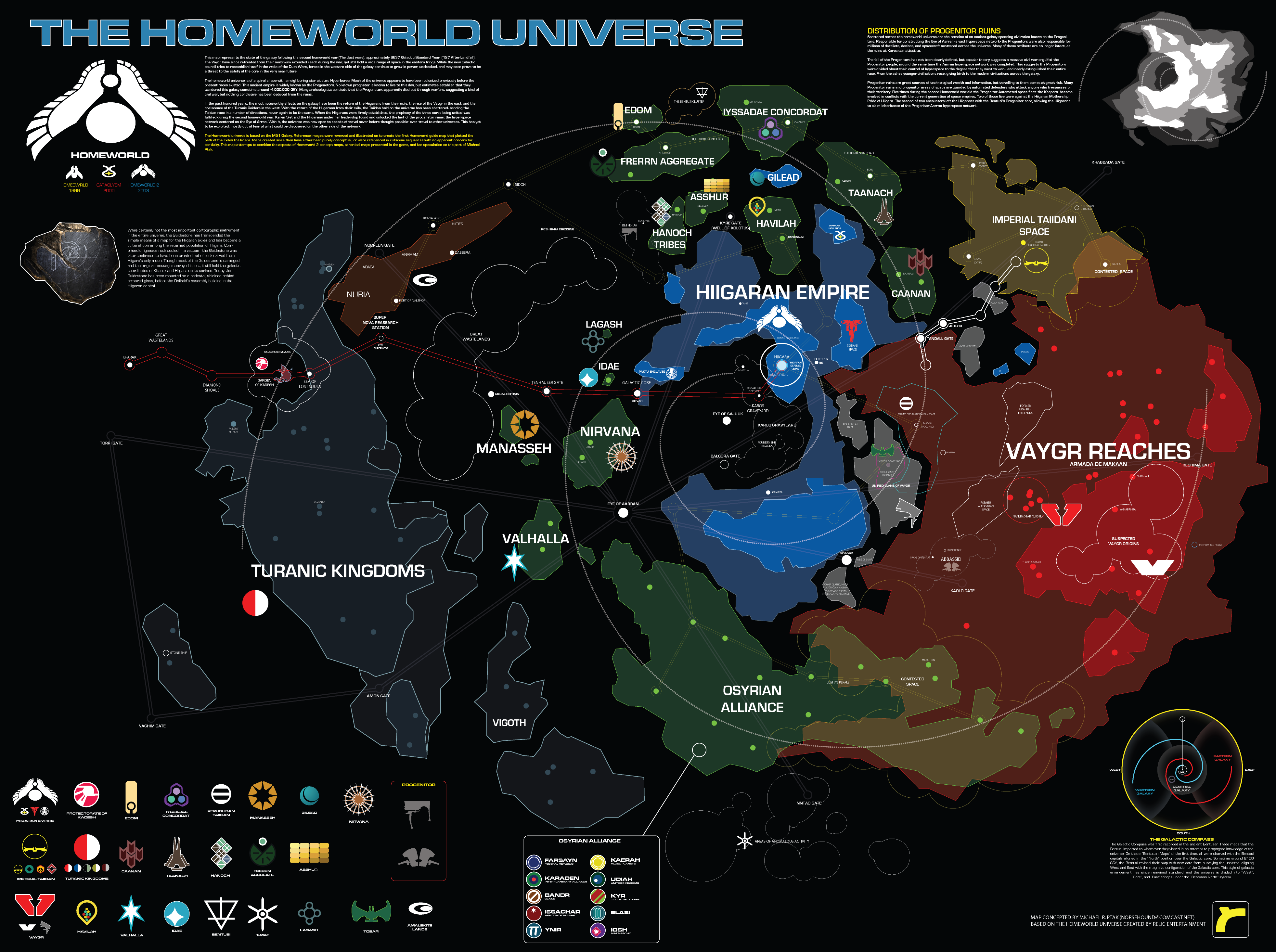
Anyway, after you destroy that outpost, lets say that a vessel present nearby (presumably some trade occurs at the outpost) happens to be from a race that opposes the Taiidan. We could make up any name for this race, though to aid us, a (speculative) map of the Homeworld galaxy can be found here - http://fc06.deviantart.net/fs30/f/2008/052/4/c/Map_of_the_Homeworld_Universe_by_Norsehound.png

A race quite close to that part of the galaxy is labelled the 'Nubians' - fine, we'll use that. Lets say the captain of this ship recognises you to be the Hiigaran exiles, and offers to aid you in your quest against the Taiidan.

You can choose to accept this offer or not. If you do, you go to the 'Nalthor Station' mission. If not, you go to 'Caesera System'.

Nalthor Station is a location not seen in any homeworld game so far, but it can be found in some Homeworld2 concept art -


At Nalthor Station however, disaster strikes. It turns out the Nubians do not actually want to help you, but instead want to hand you over to the Taiidan. A massive Taiidan fleet hyperspaces in just as the Nubians raise a huge Hyperspace Inhibitor field around you (Cathedral of Kadesh anyone?)

You would then have to disable the hyperspace inhibitors (probably taking the form of several modules spread throughout the massive station) before the bulk of the Taiidan fleet can arrive.

Sounds pretty exciting yes?

The rest of the game would follow a similar pattern. In the levels I've outlined above (and there could easily be many more, perhaps dozens in total) 'Caesera System' contains a deep space Taiidan mining base you can destroy, a lot like the 'Super Nova Research Station' in the original campaign. In this case however, a bunch of Taiidan ships show up just as you destroy the station and announce that they are in fact rebels and offer to take you to their rallying point. Once more, you can accept or reject this offer.

If you accept, then shortly afterwards the combined Rebel-Exile fleet hyperspaces to 'Vorshan's Rift'. Keen players of the original games may remember this as the site of the battle where the assembled Rebels were almost wiped by the Imperial fleet, and from which Captain Elson fled before he found you (this is explained in the Homeworld: Cataclysm manual, it also has an article on the Homeworld wiki - http://homeworld.wikia.com/wiki/Battle_of_Vorshan's_Rift).

There, you could either try and turn the tide of the battle, or retreat into hyperspace if the situation becomes too dire. If you win you could then proceed straight to the Bridge of Sighs and Hiigara, or else other routes and possibilities might be calling.

In doing all this, new content is thus created to be explored by new and old players alike, the game is further updated to rival modern series like Mass Effect and Halo and at the same time the original Homeworld storyline is kept intact.

While ambitious, I feel Homeworld could greatly benefit from such an overhaul. Gearbox, or any potential modders out there, please take note.

Tuesday, 9 September 2014

Spaceship Names - the Federation, the Empire and the Culture

In the wonderful world of space opera, an enduring question grips many an author.

What exactly do you name things in your universe?

We might go over characters, planets and civilizations another day, but for the moment lets focus on the coolest things of all to give names - spaceships!

'Eagle 5' - Spaceballs
Here we can divide our names into three broad categories - what you may could call the 'good', the 'bad' and the 'funny' or as I have called it above - the 'Federation', the 'Empire', and the 'Culture'.

The first two groups should be pretty self-explanatory. Spaceship naming conventions tend to follow the historical precedent of seagoing warship names. 'Good' names tend so sound righteous and courageous. We're talking names like 'Liberty', 'Freedom', 'Intrepid' and 'Constitution'. A lot of ships may also be named after people or places, like the WW1-era 'Queen Elizabeth' Battleships of the British navy or the current generation of 'Nimitz' class aircraft carriers in the US Navy.

The 'bad' or 'empire' category are names more intended to instill fear in an opponent. Here we have names like 'Conqueror', 'Dreadnought', 'Thunderer' and 'Revenge'.

In fiction, there are plenty of examples of different factions - depending of their benevolence, following either naming convention. Think of the 'Enterprise' from Star Trek, the 'Discovery' from 2001, or the titular 'Galactica' from Battlestar Galacica.

The opposing factions at the Battle of Endor are a telling example. The Rebel cruisers have names (most not named in the actual movie, but its all there in the manual) like 'Defiance', 'Independence' and 'Liberty' while the Imperial Star Destroyers have names including 'Executor', 'Devastator', 'Tyrant' and 'Dominator'. I recall another example from the Homeworld series of games. In a battle in Homeworld: Cataclysm between the Republican Taiidani and Imperial forces, the Republican Carrier is named 'Victory' and the head Imperial Cruiser ' Vengeance'.

These naming conventions are cool, but there's another category that has been gaining popularity lately. These are names not so much intended to inspire either courage or fear, but which are meant to rise above either, and if anything inspire humor. A lot of them are satirical in nature, drawing inspiration from famous quotes and common catchphrases. I've called it here 'Culture' names, after the titular civilization from Iain M. Bank's Culture novels.

To give a bit of background - Culture ships are generally incredibly advanced ships run by godlike-AIs, and against which their human crews are little more than passengers. They pretty much run the galaxy and maintain peace between its many different civilizations. Consequently, they have a tendency to name themselves pretty much whatever the hell they want. Wikipedia has what appears to be a complete list - http://en.wikipedia.org/wiki/List_of_spacecraft_in_the_Culture_series

Some of my favourite names include -

Irregular Apocalypse
Screw Loose
Limiting Factor
Just Read The Instructions
Gunboat Diplomat
What Are The Civilian Applications?
Attitude Adjuster
God Told Me To Do It
Well I Was In The Neighborhood
All Through With This Niceness and Negotiation Stuff
All The Same, I Saw It First
Lapsed Pacifist
Frank Exchange Of Views
Reformed Nice Guy
Killing Time
Falling Outside The Normal Moral Constraints

There's also a number of running gags in the series. One ship was called the - 'But Who's Counting?' Several books later we're then introduced to another ship called the - 'Me, I'm Counting'. Another is that, because they so often have such crazy names, critics in the Culture universe have supposedly complained that Culture ships do not have sufficient 'gravitas' in their designations. This has spawned a whole series of tongue-in-cheek names including -

Dwindling Gravitas
Zero Gravitas
Very Little Gravitas Indeed
Gravitas, What Gravitas?
Gravitas Free Zone
Experiencing A Significant Gravitas Shortfall
Stood Far Back When the Gravitas Was Handed Out
Absolutely No You-Know-What

Looking back on these three categories, and if you are looking for cool names for the spaceships in your novel/other work of sci-fi, feel free to peruse the list below. I've been thinking up ship names for quite a while now. They're a combination of names I've seen elsewhere and some of my own invention (particularly in the last category). Naturally there may be some overlap between categories as the borders are not exactly well-defined. Note also that names naturally go in and out of fashion. I've noticed that names like 'Aurora' and 'Phoenix' have been overused to the point hat they're practically cliches these days, so pick wisely.

'Federation' Names:

Discovery
Enterprise
Endeavor
Fearless
Liberty
Glorious
Indomitable
Indefatigable
Voyager
Alacrity
Challenger
Protector
Serenity
Repulse
Sentinel
Dauntless
Resolution
Hercules
Defiant
Surprise
Oracle
Destiny
Orion
Phoenix
Victory
Hyperion
Eagle
Ark Royal
Formidable
Centurion
Majestic
Illustrious
Venerable
Daring
Swiftsure
Pegasus
Genesis
Vanguard
Audacious
Valiant
Aurora
Diadem
Loyal Servant
Argonaut

'Empire' Names:

Executor
Vengeance
Conqueror
Thunderer
Devastator
Irresistible
Excalibur
Goliath
Colossus
Behemoth
Heat Death
Event Horizon
Litany of Fury
Nuclear Winter
Hellbound
Moral Chimera
Charybdis
Leviathan
Avenger
Notorious
Vehement
Invincible
Warspite
Inferno
Lucifer
Punisher
Reaper
Hurricane
Eminence
Tempest
Iron Maiden
Basilisk
Minotaur
Iron Curtain
Eternal Terror
Grievous Ordeal
Terrible Resolve
Furious Purpose
Vampire
Cataclysm
Carnivore
Hydra
Immortal
Nemesis
Hunter
Relentless

'Culture' Names:

Refuge in Audacity
Sufficiently Advanced
Under No Illusions
Perpetual Motion
Divine Intervention
Collateral Damage
Process of Elimination
Always A Bigger Fish
Daybreaker
Big Stick
Extinction Event
Ignorance Is Bliss
Only Light Is Faster
Laws of Physics
Terminal Velocity
Tenth Circle
Nothing Lasts Forever
Don't Care Who Started It
Square Peg
Satan's Little Helper
In Case Of Emergency
Playing With Fire
No Fluctuations Here
Karmic Trickster
Known Unknowns
Undue Onus
What Goes Up
Butterfly Effect
Lateral Thinking
Potentially Problematic
Without Loss of Enthusiasm
Lamentable Catalogue
Merciful Disposition
No Third Law
Two Days From Retirement
That Can Be Arranged
No Reverse Gear
Cunning Plan
Playing With Fire
Baryonic Lord
Atom Smasher
Same As The Old Boss
Residual Fear Of Hell
Highest Bidder
Challenge Accepted
Finders Keepers
Arsenal Of Damocles
Orient Map To Cosmos
Newton In The Driver's Seat
Successful Failure
No Further Appeals
Active Correction
Handling the Truth Just Fine Thank You
Point Away From Face
Unforgiving Minute
Second Best Policy
Cosmological Constant
No Plans For Tomorrow
Delaying The Inevitable
No Such Thing As Ghosts
Devil's Advocate
Uncanny Valley
Peace Agnostic

Thursday, 21 August 2014

On the Possibility of a Chinese Invasion of Australia - Part #2

Part #1 here - http://futuredemons.blogspot.com.au/2014/08/on-possibility-of-chinese-invasion-of.html

The Axis powers in WW2 faced the problem of taking on the quantitatively and qualitatively superior fleets of the Allies. While they eventually lost the war, they did devise a number of cunning strategies which certainly kept the Allies on their toes.

The Japanese for instance, attempted to deal the American navy a crippling blow on the outset of war with the attack on Pearl Harbour, and succeeded in destroying two battleships and disabling five more. While the attack was ultimately seen as a disastrous strategic blunder, tactically it was a stunning success. American and Chinese military planners must no doubt be aware of the lessons of Peal Harbour - I doubt an attacking force would miss the American carriers twice...

More than a surprise attack, there is the possibility of sabotage to whittle away an opponent's numerical advantage in ships. A famous example also occurred during WW2 when Italian divers (or 'frogmen') raided the Port of Alexandria in December 1941, placing limpet mines upon the largest British ships they could find. Two battleships and an oil tanker were disabled and put out of action for many months. The Italians lost six men captured.

Aside from such tactical loopholes, the relevancy of aircraft carriers in general may not last forever. One of the most strategically significant events of the 20th century was the launch of the HMS Dreadnought in 1906. As the first 'all-big-gun' battleship it rendered all previous warships obsolete. While one may think this would give the British a great advantage, the reality was that it reduced their naval lead over rival powers to just one ship. This greatly contributed to the naval arms race pre-WW1.

A similar event could happen in the near future, or may have happened already. While the aircraft carrier has ruled the seas since WW2, it may eventually go the way of the Battleship. Anti-ship missiles may advance to the point where large ships such as carriers are too vulnerable to operate anywhere near a hostile coastline. A Chinese missile called the 'Dong-Feng 21' has been cited in the media as such a possible 'carrier-killer', though others question if its significance has been over-hyped - http://thediplomat.com/2013/10/lifting-the-veil-on-chinas-carrier-killer/

The modern world also offers other possibilities. 'Cyberwarfare' is a term that has gained a lot of currency as the internet has spread around the world over the past twenty years. The most successful example so far would seem to be 'Stuxnet' - what has been universally suspected, if officially denied, to be an Israeli/American operation to disrupt Iran's nuclear program. Reportedly the virus disabled a fifth of Iran's centrifuges - used to enrich nuclear material. While we don't know exactly to what extent cyberwarfare may affect future battles, it could be very significant indeed. Like the machine gun in WW1 or the tank in WW2, their true significance may only be seen in hindsight.

Lessons like this then, show that the American's advantage, while great, is not necessarily insurmountable in the long run. After all, there are only ten Nimitz-class carriers. At any given time several of these will need to be in dock undergoing maintenance, and stationing all the others off the Chinese coast at once would probably be impracticable.

Thus, if through a combination of surprise and sabotage the Chinese took out three or four of them, and assuming their own carrier building program comes to fruition over the next decade or two, they could just about achieve parity with the American navy in the South China Sea at the opening of any conflict. This combination of events would still be decades away however.

But lets assume the worst. Lets say that, around the year 2050, the Chinese and Americans wage a major war on land or at sea. Possible triggers for this conflict could be found in the Middle East, Kashmir, Korea or Taiwan. Lets further conclude that the Americans lose, and are forced to withdraw from the western Pacific and accede to Chinese dominance over the region. Others have written about this possibility -
http://www.hudson.org/research/8885-defeat-at-sea-the-u-s-naval-implosion-of-2050/

As well as myself -
http://futuredemons.blogspot.com.au/2011/06/world-war-three-united-states-and-china.html

Again, this would all be a necessary prelude to an invasion of Australia. Aside from kicking out the Americans, the Chinese would have to neutralize - through force or diplomacy, all of the intervening nations between us  (i.e. Japan, South Korea, Taiwan, Vietnam, the Philippines, Malaysia and Indonesia).

Such a chain of events may be possible, but we're talking a seismic shift in international politics, one on the scale of the world wars. Nonetheless, the Japanese did manage to achieve most of this, albeit briefly, in the 1940s -


It would still take an enormous effort to mount a full-on invasion of Australia however. The distance from Hong Kong to Darwin is over 4,000km. For an invasion fleet to cross this distance, the invading power would need to have attained naval supremacy over the western Pacific region. A dozen Los Angeles-class submarines could put such an invasion force in jeopardy, so there would have to be a total collapse or withdrawal in US naval power for this to occur. This is not to mention our own Collins-class submarines.

One wonders roughly how many troops and ships you'd need to assemble in the first place, assuming you could safely transport them this distance. Australia is a big, big country. The only amphibious invasion of comparable size in all history, indeed, the only other amphibious invasion of a whole continent, would be the Normandy landings in June 1944.

Of course Australia's population is much smaller than Europe's, but the Allies in 1944 were not opposed by the French, but by the occupying Germans. As Hitler had committed most of the Wehrmacht's strength on the Eastern Front, roughly a million German soldiers remained to hold France.

By 2050, Australia is estimated to have a population of about 40 million. Using the World Wars as a guide (i.e. the last time industrialized nations fully mobilized for war) roughly one in ten people in a developed country can be put in uniform without collapsing the economy. This gives us a similar figure. It may even be an underestimate. Australia in WW2 had only 7 million people, yet just over a million served in all branches of the armed forces in total. Thus, we could conceivably put 2-3 million soldiers into the field.

Equipping them is another matter, but even if the Americans did not want to be drawn into a war directly, it would be simple for them to ship a few thousand excess tanks, guns and planes to Australia. Such a 'lend-lease' program to Britain and the other allies provided millions of tonnes of armaments during WW2. Given the necessity of the events described above, Australia would presumably have some years to prepare for an invasion.

Preparations for Normandy took years. The Allied invasion force eventually included some 7,000 ships, including 1,200 warships, 1600 support vessels and over 4,000 transport and landing ships. More than 150,000 troops were landed on the first day, and some three million by D-Day +90. Some 10,000 planes supported the invasion.

Even then, this armada only had to cross the English Channel, a distance of about 240km. This is comparable to the 130km width of the Taiwan Strait, a distance the Chinese probably could cross and perhaps even defend against American intervention, but Australia is thirty times more distant.

The largest long-distance amphibious invasion would probably be the American invasion of Okinawa in 1945, which involved 1300 ships, less than a quarter of the Normandy figure. Okinawa itself had about 500,000 inhabitants and a land area of 2,300 km2 - comparable to the ACT in Australia.

Admittedly Operation Downfall - the planned invasion of mainland Japan - would have been even larger. The Allies began assembling 42 carriers, 24 battleships and over 400 destroyers and other major warships for the landings. Even this vast fleet however, would have required the support of nearby bases like Okinawa to maintain.

As a preliminary to invading Australia then, the Chinese or anyone else would have to seize bases nearer to Australia as staging grounds. East Timor, the Solomon Islands or New Caledonia come to mind, or ideally they could bully or bargain with the Indonesians.

Even then however, there is the question of where in Australia you land your forces. When the Allies landed at Normandy in 1944, they were less than 200km from the Eiffel Tower.

As far as Darwin is from China, it is another 3,000km to Melbourne, comparable to the distance between Paris and Moscow. Northern Australia is only sparsely populated. Some 80% of Australians live in a broad coastal strip in the south and east between Adelaide and Brisbane.

Operation 'Death to the Foreign Devils Down Under' - June 2054
Upon landing in the north, any invaders would have to cross some 3,000km of jungles, deserts and mountains to reach Australia's main population centres. They would be vulnerable to air attack, ambush, roadside bombs and all other manner of man-made hazards all the way - not to mention cyclones, bushfires, saltwater crocodiles, red-back spiders, tiger snakes, box jellyfish and the dreaded drop bear...things which normally deter people from heading to Australia in and of themselves.

Finally, assuming that all of the above still happens, and the People's Republic of Australia is declared circa 2060, one wonders exactly what the invaders will have gained? They will have spent trillions of dollars building up a vast military machine, launched it on a war that will have killed millions of people, likely collapsing the world economy in the process, and ended up with...what?

We already sell billions of dollars worth of iron ore, coal and other minerals to Asia. The country is relatively underpopulated at present, but at half a million extra people a year it couldn't be growing much faster. Given that most of it is desert as well, it would be hard to support a much larger population anyway. A hundred million by 2100 is a remote possibility, but given China's projected population of 1.5 billion by mid-century, only a tiny portion of the excess could be resettled in Australia. Despite fears of a population explosion, most Asian countries have just about finished growing anyway, and many are coming to suffer from low birth rates. The one-child policy in China may actually leave them with a labor shortage in another generation or two.

So no, Australia is not the place to invade if you want more lebensraum, unless your master race is particularly fond of sand and giant earthworms.

One more scenario worthy of consideration are the after-effects of a major disaster affecting the nations north of Australia. If the severity of climate change exceeds most expectations, sea levels could rise by several feet by 2100. This would flood many coastal cities, potentially producing hundreds of millions of refugees worldwide. Other causes could be a major nuclear exchange, the sudden onset of a new ice age (not as remote a possibility as one may think), a terminator-style machine revolt, an asteroid strike or a technological singularity, beyond which all our predictions may be worthless.

All of these events, no kidding, may very well happen over the next century. Events away from our borders of this scale will most definitely affect us. The results would be more on the order of a 'massive wave of refugees' than an organized invasion however. Think of the few thousand 'boat people' we've had recently, and imagine what a few million may be like. If anything, this possibility is more likely than the organised invasion described above.

So yes, all that, Senator Lambie, is what it would take for a foreign invasion of Australia to occur.

Happy warmongering.

- DT